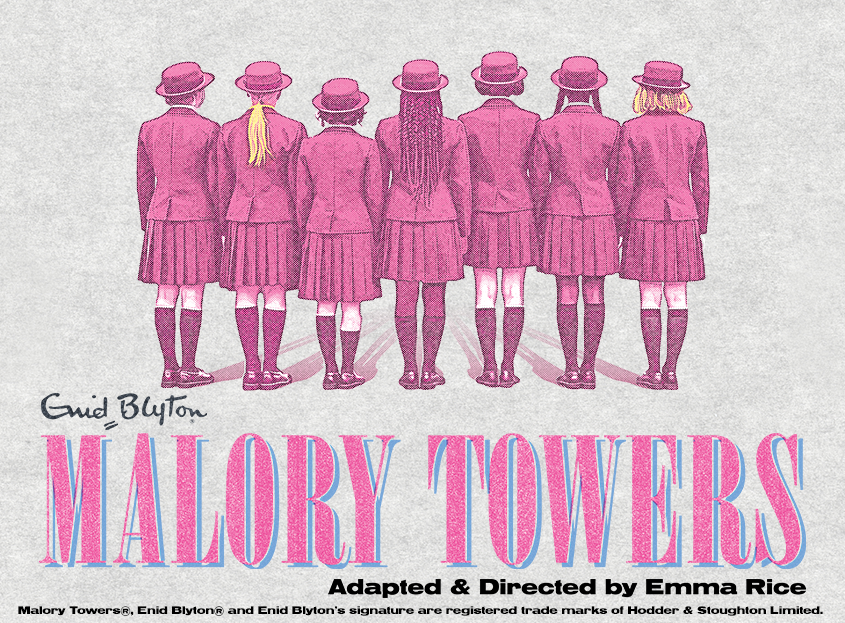
Malory Towers is a series of books written by still-omnimpresent children’s writer Enid Blyton, most well-known for The Famous Five series. As the programme for this show says, in 2017 she was still the 12th most popular children’s author, with her books being the most translated works for children in the world (UNESCO). Active from the late 1930s to the early 1960s, her books mainly centre around groups of children having wholesome adventures, shot through with a moral, good-intentioned spirit that prizes bravery and treating others with kindness. Malory Towers came after the release of The Magic Faraway Tree and with the Famous Five series well underway, and follows Darrell Rivers as she starts at and progresses through the idyllic Cornish boarding school that the books are named for.
For every person who stared blankly when I mentioned I was going to see a stage adaptation, there were others – primarily, but not all, women – who burst into smiles and talked about how much they had loved the books when they were younger, and how they represented both a fantasy of boarding school and of secondary school in general. Arriving at the theatre, there was a sea of tween girls accompanied by parents and grandparents; even if attending boarding school is a far rarer experience in 2026, particularly a single-sex one where all the children are from the UK and attend full-time, the fantasy of wholesome boarding school life has very much not lost its appeal. The show is adapted and directed by children’s theatre legend Emma Rice, and this is its second time on tour.
We start out in a modern secondary school, with a character dressed as Titania from A Midsummer Night’s Dream being bullied and teased by a loud and rabunctious group of girls. When she falls and is knocked out, we flash back into the late 1940s and the 2020s girls become the more formal, RP-voiced ones of Malory Towers, keeping the same lively enthusiasm. We meet Darrell (Robyn Sinclair) and her new classmates as they all gather on the train to Cornwall; the other girls are well-defined archetypes, with an immediate villain emerging in the form of spoilt Gwendoline (Rebecca Collingwood, who originated the role in 2019.) As they travel to the school, animations of their journey are projected on the background school scenery which feels inventive and exciting. Settling in their dormitory, they share their excitements and worries and we see them start to explore their new world, meeting headteacher Miss Grayling (voiced by Sheila Hancock, but taking the form of a projection), exploring the tidal pool and taking in their first lessons. The former is especially fun, with great use of puppets (by Lyndie Wright) to show the girls diving in before the actors reappear.
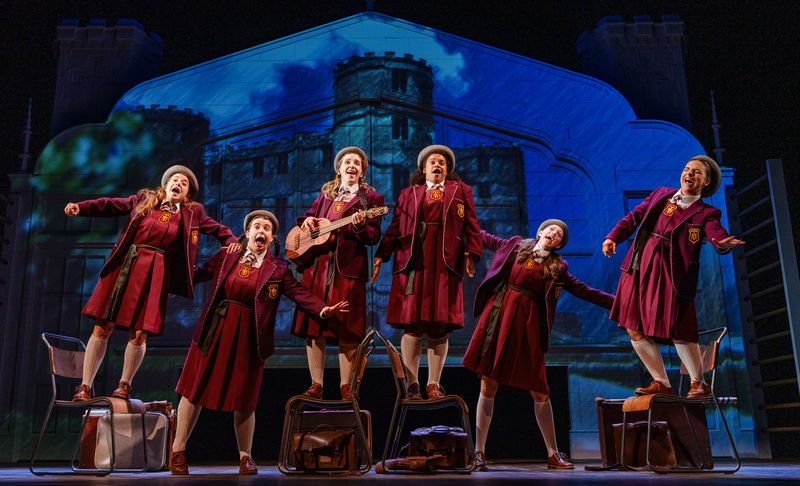
Gwendoline quickly becomes more villainous, persecuting the fragile Mary-Lou (Eden Barrie, her earnest fragility reminding me of Lily in Sex Education); these encounters feel genuine and charged with fear. We are also joined by Bill (Zoe West), who entrances the girls with her outdoorsyness and the presence of her beloved horse, Thunder. The stories have been adapted and condensed for this stage version – Bill doesn’t turn up until the third book in the series – but, along with the cheerful songs and gentle incidental music, this keeps things moving along at pace. The actors are all excellent dancers and singers, especially Barrie and French musician Irene (Stephanie Hockley, also musical director), with the latter playing piano as well (Emily Panes also features on violin and piano, with West playing drums and guitar.) They’re also convincingly uninhibited and lively, despite being past secondary school age.
Sinclair anchors the action well as Darrell, well-meaning but sensitive to injustice and prone to anger – although always because she feels too strongly, never unjustifiably. There is a strong sense of earnestness and honest perserverance in the face of adversity throughout, as there is in the books; acting unkindly or being lazy are flaws that the girls have no patience for, which can feel slightly relentless and jolly hockeysticks despite their good intentions. The cast is refreshingly diverse, but the earnestness is the one aspect that can make it feel slightly dated, even though the cast hits every beat of the more sombre moments with sincerity. Gwendoline’s arc is very well done (Collingwood having excellent fun, at one point shouting from the audience), especially the emotional climax, and a dramatic cliffside scene is elevated by the animations and use of puppet arms and legs dangling in the air. It would have been interesting to get more of a sense of the larger school community, as the huge ecosytem and traditions are both overwhelming and intriguing to Darrell in the books, and make her new environment feel well-rounded and enveloping.
Any small qualms I had however were very much in the context of my age and dwarfed by the enjoyment of the audience – a strong moral core underpins a vibrant and lively show. My plus one Josie, who is seven, was definitely on the young side compared to the other girls there, but she giggled throughout and loved the diving board sequence and Gwendoline’s appearance in the crowd. She loves the Famous Five and prepared by listening to Tales from Malory Towers, a more recent BBC Sounds series by new writers. We were unsure if she would make it through the whole show as she was very tired earlier in the day, but she insisted on staying for the second half and when we got home, offered a definitive ‘I liked it.’
Malory Towers is on tour now.