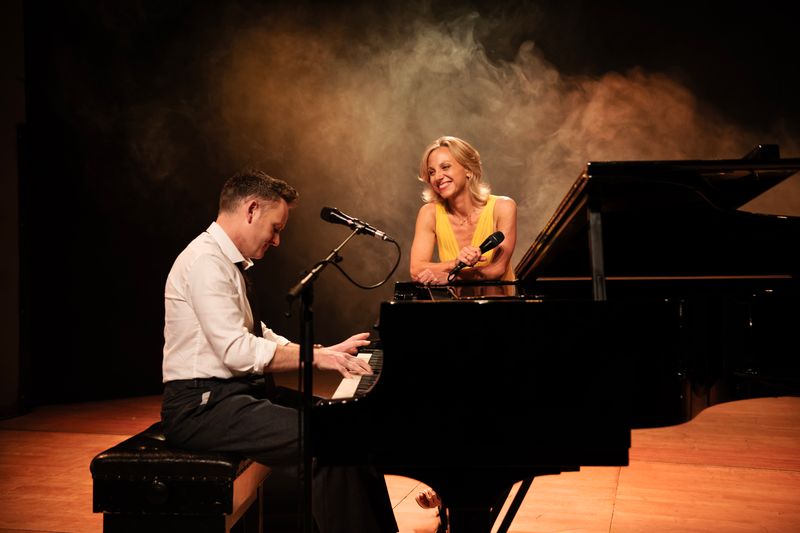
The last show I saw in the Ustinov was ‘The Last Five Years,’ by Jason Robert Brown, and it seems only right to return for a wider celebration of movie musicals – ‘Hooray for Hollywood,’ as performed by Liza Pulman and Joe Stilgoe, with the latter also playing the piano.
The stage is set with appropriately Hollywood accessories – director’s chairs, big lights, and a double bass on its side. Stilgoe and Pulman get straight into it, singing an original song about their passion for movie musicals, with snatches of ‘Tonight,’ from West Side Story and ‘Wilkomen,’ from Cabaret thrown in. Then, we’re into the show proper, which takes the form of an intimate cabaret as the two perform their favourite songs, with patter in between. The latter is somewhat tame and occasionally feels over-rehearsed, although Stilgoe especially is given more room for pithy improvisation particular to Bath and the audience, which goes down well.
They tend towards singing snatches and medleys of songs, such as ‘City of Stars’ from La La Land and the titular song from Singing in the Rain, but it means it takes a little while to gain momentum, and they’re on stronger ground when they let the music breathe with longer moments of song; a fun ‘If Only I Had A Brain,’ from The Wizard of Oz allows Stilgoe to take a break from the keys and show off his skills on the double bass, making for a fresh and exciting take on the song. When Putnam takes a break, Stilgoe shows off his piano proficiency with a rapid-fire performance of famous film scores; while these were impressive and great fun, it felt like a missed opportunity for a stripped-down solo. When his co-star returns, we are treated to a full version of ‘Maybe This Time,’ from Cabaret, which shows off the full power of Pulman’s gorgeous voice; it also really suits the older songs, such as ‘Spoonful of Sugar,’ from Mary Poppins and ‘Wouldn’t It Be Loverly,’ from My Fair Lady.
There isn’t a particular narrative, just a general theme, with the assumption that the crowd will be familar with most of the songs and films the two mention. But perhaps it might’ve been interesting to have a little more background, or their opinions on what made them and their stars especially enduring. The most successful medley is of ‘Somewhere,’ from West Side Story and ‘Sunrise/Sunset,’ from Fiddler on the Roof, which was made more powerful by Pulman’s anecdotes of helping her father tape the film, and Stilgoe’s eulogising of the recent Regent’s Park Open Air Theatre production. The emotional weight of the songs allowed for a moment of stillness and really let their vocals shine with just the piano backing them. An underrated late highlight was ‘No One is Alone,’ from Into the Woods; I suspect the crowd were there for the older classics. While it was more understated with just two performers, it was lovely to hear with just them and Stilgoe’s accompaniment, and the blending of their two voices was beautiful – they used less vibrato than in some of the cast recordings, which made it feel refreshingly grounded.
Overall, I think the show could have benefited from some narrative and book tightening – it didn’t feel like we quite got to the bottom of what exactly is so special about the movie musical, especialy Golden Age ones, even though there was a huge variety of songs that demonstrated the range and history on offer. However, it was a testament to years of musical training and a genuine passion for the form that laid the foundation for the movie musicals we watch today. The Wizard of Oz walked so that Wicked: Part I and Wicked: For Good could run, after all.