
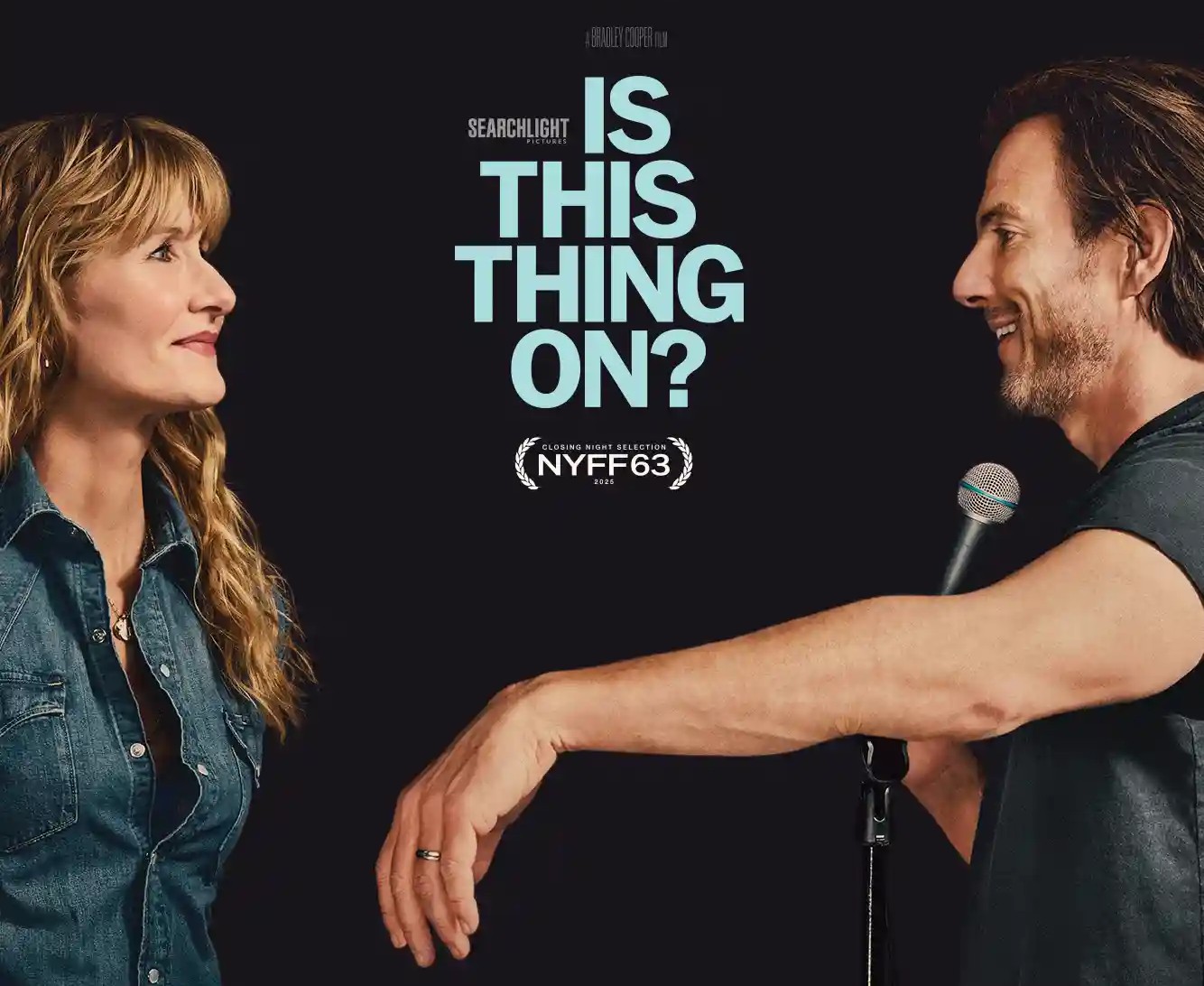
One night in the early 2000s Manchester, John Bishop was performing stand-up. He’d begun some months previously on a whim, after taking a spot to avoid paying the venue’s entry fee. In the final stages of a divorce, he was telling a joke about his soon-to-be ex-wife when he unmistakeably heard her laugh in the crowd. Like everyone in his life, she had been unaware he was even doing stand-up. He managed to finish the set, and afterwards she came up to speak to him. She said that it reminded her of how funny and happy he was when they were first married. Ultimately, they decided to stay that way.
Nearly thirty years later, this leads us to ‘Is This Thing On?’, a film of their story, starring Will Arnett and Laura Dern as Bishop and his wife Melanie. The story has been tweaked a bit in the adapting; the latter were in their mid-thirties and struggling with the demands of raising three young children when they were divorcing. By contrast, Arnett and Dern are both in their fifties, although their characters still have kids -two ‘Irish twin’ boys, born after considerable struggles with IVF, with whom they live comfortably in upstate New York.
We begin at a school assembly, with Alex limply disengaged from the action as a Chinese New Year celebration happens around him. He and Tess (Dern) are struggling with the everyday sadnesses of a relatively amicable seperation, and this is juxtaposed with the flailing relationship of their friends, actor Balls (Bradley Cooper, also directing) and Christine (Andra Day.) As Bishop did, Alex finds himself performing after refusing to pay the entry fee for a downtown comedy club, filmed on location at the legendary Comedy Cellar in New York. He stumbles through a makeshift set, self-deprecatingly musing on the miseries of divorce. Cooper is arguably too keen on close up shots, but there’s no denying that they make Alex’s defeated weariness inescapable, and Arnett excels at conveying it. He returns to perform again and again, building a sense of self and camraderie with his fellow comics.
It does feel like somewhat of a reach that not only is Alex unequivocably welcomed into such a surely competitive epicentre of comedy (one of the other comics observes on very little basis ‘You have a good heart’), his unfashionable identity as an older, straight white man is not commented on, given that he’s in one of the most diverse cities in the world. It’s one of the reasons – along with his young children – that Alex being in his mid-fifties feels slightly jarring. Not that this should stop him, but it’s another aspect of the experience which isn’t interrogated; his fellow comics don’t enquire why it took him this long to try stand-up, for example, and the comedy scene is presented as a utopia of personal expression waiting to embrace lost souls. It also seems like a misfire that although we often see him dressed for work, we never actually see him at it, which might round out how he feels unfulfilled.
We see Alex’s mood brighten, and his gigs function as updates for the audience on his emotions as he explores dating and life as a newly single man. However, at no point is the concept of a tight five, structure and pacing, or even refining material through repeated performances mentioned. Add to this the fact that the romantic reunion comes considerably sooner than one might expect, and the film shifts to trying to be a character piece about self-actualisation, not focusing sufficiently on either our protagonist’s journey in comedy or the rekindled relationship to feel substantial. Unfortunately, Tess isn’t well drawn enough either for us to really feel invested in her, despite Dern’s charisma. The film beginning with her and Alex’s seperation means that we don’t see enough of the pain that led to it; the laboured and over-earnest dialogue during the longer emotional scenes makes it all the more frustrating, and their reunion ultimately feels unearned.
We meet Alex’s parents (Christine Ebersole and Ciarán Hinds), scene-stealingly fussy yet content in a long marriage, but it’s the parallel relationship and characters of Christine and Balls that feels more pertinent. However, both feel oddly hollow. Balls (Cooper) has some great comedic lines, but his character’s lack of development leads him to come across as more ignorant and unhelpful than unaware and funny. Somewhere, there is a film that contrasts his sporadic work as an actor, beholden to the whims of other more powerful creatives, with Alex’s experience of finding joy and freedom in performance, entirely in charge of his own creative destiny. Sadly, this is a film that meanders unsuccessfully – despite the talent involved, it never quite manages to make the statements it intends.