
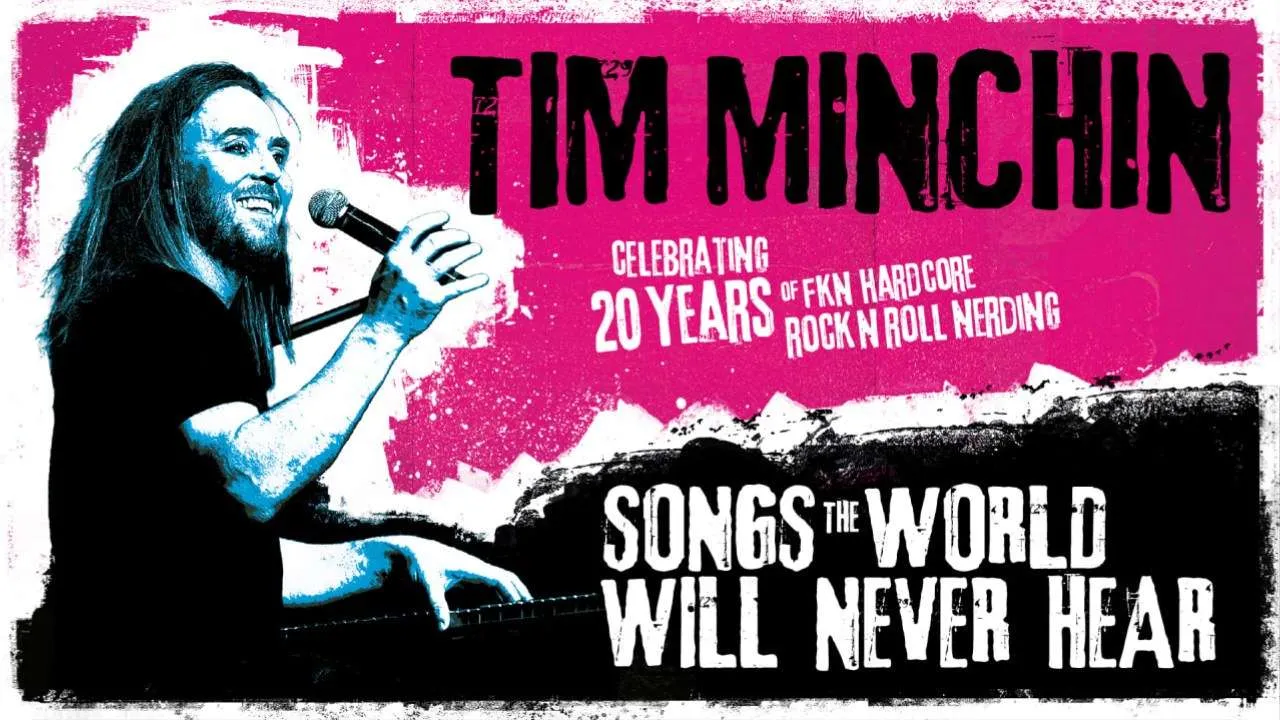
Tim Minchin came to the Edinburgh Fringe in 2005 for the first time with his debut show ‘Dark Side’, which was nominated for and then won the Perrier Award for Best Newcomer. Winning this for your debut show is the kind of wildest fantasy for aspiring comedians that is so vanishingly rare, such a golden ticket to the upper stratosphere of the comedy ecosystem, that it’s not really worth bothering to dream about. (He came having just won the Melbourne Comedy Festival’s Director’s Choice award, which got him a decent-sized theatre, but it was still a barnstormingly sudden and successful arrival on the scene. Arguably, the now-renamed Perrier Award is less of a golden ticket to ubiquity in 2025 because of the decline of TV and general silo-ing of culture, but it’s certainly a massive shot in the arm that any comic, debuting or otherwise, would sell their aforementioned arm for.)
His friend Rhian Skirving followed his preparation for and the Edinburgh run of Dark Side – and the insane aftermath – in her documentary Rock and Roll Nerd. Rewatching it after this latest show, it’s impressive to see Minchin’s level-headed savvy both in terms of his own branding and strategy, and in response to the sudden huge interest and offers coming his way as his show takes off almost instantaneously (with the exception of an infamous one-star review from Guardian reviewer Phil Daoust.) Daoust’s piece is distinctly savage, but there’s a grain of bitter truth in it – musical comedy can often be a lazy variant of stand-up. It’s easy to accentuate and undercut jokes with your instrument, and a good hook or catchy tune can make even the lamest jokes seem more novel. Minchin came onto the scene a rough gem, but a gem nonetheless, and considerably more fully-formed than many of his peers, marking himself out by the level of his skill.
Post-Edinburgh, he launched straight into a UK tour, and his career only rocketed upwards for some time. Before you could blink he was selling out arenas and performing with huge orchestras, establishing a reputation as an anarchic, philosophical science nerd with a cheeky twinkle in his eye – and in America, as either a heathen who needlessly persecuted well-meaning Christians, or as a welcome cynical voice calling out the hypocrisies of the church. At the peak of his powers and visibility, he returned to his roots in musical scores and composition to take up a commission from the RSC, writing what would become the Broadway and West End-conquering behemoth Matilda. I managed to time my discovery of his work perfectly to his break from live performances, discovering Matilda by accident when I was looking for music to download for our annual driving-heavy family holiday to the Scottish Highlands. Its anarchic, inventive score was a fresh and delightful soundtrack to our many long drives, and from there I was hooked, watching his back catalogue of performances on YouTube. His online content has been historically spotty, and often came in the form of single songs performed on TV shows or at comedy galas, with most of his music formally released as live recordings. It felt enjoyably anti-commercial and underground even as an act who’d recently filled the Albert Hall.
In the aftermath of Matilda‘s success, Minchin pivoted again, moving to LA and suffering the indignity of his debut animated feature Larrikins being shelved in a studio takeover, before moving back to Australia, writing an acclaimed musical of the film Groundhog Day, and releasing his first ever studio albums. This is a simplified biography; he’s been fortunate enough to do things as varied as play Judas in an arena tour of Jesus Christ Superstar, write and star in a successful TV show, Upright, and publish a book of his various commencement speeches at universities. In 2018, he returned to live performing, doing a tour called ‘Back: Old Songs, New Songs & Fuck You Songs.’ I saw both the original tour and the encore version, which bolstered his music with a spectacular brass band. It’s odd to have only seen him perform through a retrospective lens – Minchin has long ago not had anything to prove, picking and choosing his songs as he feels relevant to the show narrative. His oeuvre is so extensive that he even did a small tour in 2023, ‘An Unfunny Evening with Tim Minchin,’ which was focused on his more melancholic work and was considerably stripped-back.
It’s a testament to how much I like his work that I not only travelled from Bristol to Oxford to see the show, but I also did this on one of the hottest days of the year; it was a cosy 32°C in the theatre, and inside it was covered in signs encouraging us to drink water and alert staff if we felt unwell. Nobody did that I noticed, but it would have been an uphill slog for a less well-known performer – there was definitely a noticeable limpness where I was in the circle, as people feebly fanned themselves with whatever they could find (in the interval, I saw someone pressing a bag of frozen peas to their neck. It was unclear whether they’d been organised enough to bring it with them or the front of house staff had rustled it up.) Minchin emerges barefoot on the risen platform at the back of the stage, beginning the show with a short, typically theatrical new song telling us to turn our phones off, giving us a minute on the backing screen before promptly vanishing. Then we’re into a sweetly nostalgic video of him performing a cabaret show in Melbourne before he hit it big, wearing his natural curls and without his trademark eyeliner. Screen Minchin begins to play Rock N’ Roll Nerd, and the video cuts through his performing it in different settings as his career ascends, before he returns to the piano onstage to play it live. It’s one of his classics for a reason, and it’s a great start. This time, there’s no brass band (‘You only need one trumpet’) – one of them was performing with Raye at Glastonbury, so clearly they’re managing okay – but four excellent backing musicians, including stalwart Jak Housden. The stage is busy but practical; the elevated platform at the back, the band on raked staging on the right side, Minchin and his piano on the left, and a platform joining them for travelling antics mid-song.
Minchin isn’t especially known for his voice, but it’s excellent and he sounds great in a way that doesn’t quite come across in his recorded work. The bashfulness visible in the gaps between songs in his earlier career is long gone; he’s effortlessly casual and cheeky, expertly pacing a long pre-amble about mole wordplay in the puerile Confessions (I Love Boobs) while simultaneously mocking his own inability to stop himself explaining the joke to death. The affection in the room is palpable, and it’s lovely to see some early classics that haven’t had airtime in a while, like Lullaby and Take Your Canvas Bags, which gets a dramatic, dry ice-heavy treatment – at one point an audience member is given a handheld fan to cool Minchin’s bare chest. It encapsulates his shows perfectly; he’s experienced and casual enough to be able to wink at the ridiculousness of what he’s doing, but he also can’t resist embracing his innate theatricality.
He’s technically here to promote his new album, ‘Time Machine,’ and the set features a few of the songs, including ‘Song of a Masochist,’ about his brother’s struggles with a girlfriend and ‘Ruby,’ about a friend who’s arguing with her mother. They’re great fun, and no one could accuse him of scaling back his act or energy despite the heat, although I personally missed the new twist on some of the older songs given by the brass band. ‘Back,’ possibly had more room for reflection on his journey through the entertainment industry – including some still-present bitterness about his experiences in America – and it felt that this show was very much in a celebratory rather than reflective mood, with Minchin discussing adding things to the show and enjoying the process of watching it evolve with such a fun team of great musicians.
An understated new song, ‘Peace,’ is a late highlight, showing off his talent for serious lyrics. I would have enjoyed a little more room for lessons he had learnt and future plans, especially given the presence of videos from his cabaret days – in Skirving’s documentary, he reflects poignantly on the purity of creating art for the sake of it, rather than because of the newly-arrived slavering crowds who are yearning for fresh songs (that have to be as good as the previous ones.)
The show almost finishes several times; we have an epic encore of Dark Side, and then White Wine in the Sun, accompanied by Melbourne Tim on the screen. Few performers could get away with such self-indulgence on a day as hot as this after an already long show, but Minchin manages it. He accomplishes a significant feat – the nirvana of not only being held in immense affection by the audience, but it being fully justified by years of stage time and pure showmanship.